
Shampoo Classification Checker
Enter the name of a shampoo and select the features that apply to it to determine its legal classification.
Have you ever stared at the back of your shampoo bottle, scanning the ingredients list, and wondered why it doesn't say "drug" or "cosmetic" in big bold letters? You aren't alone. It’s a confusing world out there, especially when one bottle claims to stop hair loss while another just promises shine. But here is the real question: Is shampoo considered a cosmetic?
The short answer is yes. In most cases, shampoo is legally defined as a cosmetic. However, if that same bottle claims to treat dandruff or prevent baldness, it suddenly wears two hats. It becomes both a cosmetic and a drug. This distinction isn't just legal jargon; it changes how the product is tested, regulated, and what you can actually expect from it.
How Regulators Define Cosmetics
To understand where shampoo fits, we have to look at how governments define these terms. In the United States, the Food and Drug Administration (FDA) sets the rules. According to the Federal Food, Drug, and Cosmetic Act (FD&C Act), a cosmetic is any article intended to be rubbed, poured, sprinkled, or sprayed on, introduced into, or otherwise applied to the human body for cleansing, beautifying, promoting attractiveness, or altering the appearance.
Notice the key words: cleansing and beautifying. If you use a product to wash dirt off your skin or make your hair look smoother, it falls squarely under this definition. So, standard shampoos that clean your scalp and condition your strands are cosmetics. They don’t need pre-market approval from the FDA before they hit the shelves. Instead, manufacturers are responsible for ensuring their products are safe and properly labeled.
This differs significantly from countries like those in the European Union. Under EU Regulation 1223/2009, the definition is similar but the regulatory burden is higher. Every cosmetic product placed on the EU market must undergo a safety assessment by a qualified person and be notified via the CPNP portal before sale. So, while the definition remains "cleansing/beautifying," the compliance steps are much stricter across Europe compared to the US.
When Shampoo Becomes a Drug
Here is where it gets tricky. What happens if your shampoo does more than just clean? If a product makes a claim about changing how your body functions or treating a disease, it crosses the line into being a drug. The FDA defines a drug as an article (other than food) intended to cure, mitigate, treat, or prevent disease.
Consider anti-dandruff shampoos. Dandruff is often viewed as a medical condition involving flaking and itching. Therefore, a shampoo containing active ingredients like zinc pyrithione, selenium sulfide, or ketoconazole is considered an Over-The-Counter (OTC) drug. These products must follow strict monographs-specific guidelines that dictate allowed ingredients and concentrations.
If a brand markets a shampoo as "anti-hair loss" or "promotes hair growth," they are making a drug claim. Minoxidil, for example, is a drug ingredient often found in topical solutions, but if added to a rinse-off shampoo, the regulatory scrutiny intensifies. Without proper drug approval, such claims can lead to warning letters from regulators. This dual status means some shampoos are "combination products," subject to both cosmetic and drug regulations.
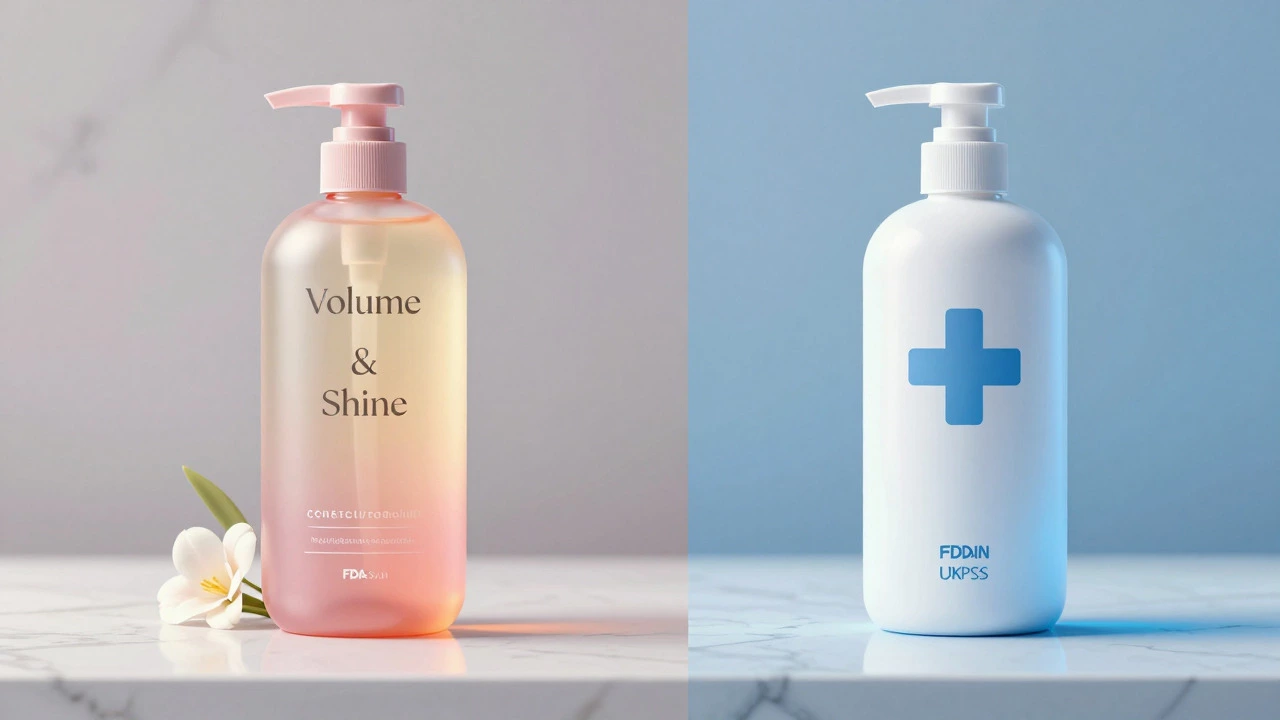
| Feature | Cosmetic Shampoo | Drug Shampoo (e.g., Anti-Dandruff) |
|---|---|---|
| Primary Purpose | Cleansing, beautifying, styling | Treating conditions like dandruff or seborrheic dermatitis |
| Active Ingredients | Surfactants, fragrances, silicones | Zinc Pyrithione, Ketoconazole, Selenium Sulfide |
| FDA Approval Needed? | No (Pre-market approval not required) | Yes (Must comply with OTC Monograph) |
| Labeling Requirements | Ingredient list, net weight, manufacturer info | Drug Facts panel, warnings, directions for use |
| Example Claims | "Adds volume," "Shines," "Moisturizes" | "Reduces flakes," "Treats dandruff," "Prevents hair loss" |
The Role of Active Ingredients
The presence of specific chemicals dictates the classification. In cosmetic shampoos, you’ll find surfactants like sodium lauryl sulfate (SLS) or milder alternatives like coco-glucoside. These lift dirt and oil from the hair shaft. Conditioners add cationic polymers to smooth the cuticle. None of these change biological processes; they only affect physical appearance.
In contrast, drug shampoos rely on pharmacologically active agents. Zinc pyrithione works by inhibiting fungal growth on the scalp, addressing the root cause of dandruff. Ketoconazole is an antifungal agent used for more severe cases. Because these ingredients interact with biological systems, their concentration is tightly controlled. For instance, the FDA limits zinc pyrithione to no more than 1% in leave-on products and slightly higher in rinse-off formulations to ensure safety.
It’s also worth noting that natural doesn’t mean non-drug. Tea tree oil, for example, has antifungal properties. If a brand claims tea tree oil "treats fungal infections," they are making a drug claim. If they say it "refreshes the scalp," it stays cosmetic. The intent behind the marketing language is just as important as the ingredient itself.
Why This Distinction Matters to You
You might think, "Does it really matter if it’s a drug or cosmetic?" Actually, yes. It impacts safety standards and transparency. Drug products require rigorous clinical testing to prove efficacy and safety before they can be sold. Cosmetic products, while still required to be safe, do not need to prove they work as advertised through clinical trials in the US. A shampoo claiming to "reduce frizz" doesn’t need scientific proof that it actually does so, whereas an anti-dandruff shampoo must demonstrate it reduces flaking.
For consumers with sensitive scalps, understanding this helps avoid irritation. Drug shampoos often contain stronger actives that can dry out hair or cause allergic reactions if overused. Cosmetic shampoos generally focus on gentler cleansing agents. Knowing which category your product falls into helps you manage expectations. Don’t buy a cosmetic shampoo expecting it to cure a chronic scalp condition; you’ll likely end up frustrated.
Global Variations in Regulation
Regulations vary wildly depending on where you live. In the UK, post-Brexit, the rules have diverged slightly from the EU. While the core definition of a cosmetic remains aligned with EU Regulation 1223/2009, the enforcement bodies differ. The Office for Product Safety and Standards (OPSS) now oversees cosmetics in Great Britain. This means a shampoo sold in London might have different notification requirements than one sold in Paris, even if the formula is identical.
In Asia, countries like Japan and South Korea have their own stringent frameworks. Japan’s Quasi-Drugs category includes many hair care products that fall between cosmetics and drugs, covering items like hair growth tonics and specialized treatments. This creates a complex landscape for global brands trying to maintain consistent labeling across borders.
Navigating Marketing Claims
Brands are clever. They often walk the fine line between cosmetic and drug claims to avoid costly drug approvals. Look for phrases like "supports healthy hair" instead of "treats hair loss." Or "helps reduce the appearance of flakes" rather than "cures dandruff." These are carefully worded to stay within cosmetic boundaries while appealing to consumers seeking therapeutic benefits.
As a savvy shopper, read the fine print. If a product lacks a "Drug Facts" panel but claims to treat a condition, it might be operating in a gray area. In the US, the FDA monitors these claims closely and issues warning letters to companies that overstep. Checking recent FDA enforcement reports can give you insight into which brands are playing fair and which are stretching the truth.
The Future of Hair Care Regulation
The landscape is shifting. There is growing pressure for stricter cosmetic regulations in the US, similar to the EU’s Modernization of Cosmetics Regulation Act (MoCRA) passed in 2022. MoCRA expands FDA authority over cosmetics, requiring facility registration, product listing, and adverse event reporting. While it doesn’t reclassify shampoo as a drug, it closes many loopholes regarding safety substantiation. Expect to see more detailed ingredient disclosures and safety data available to consumers in the coming years.
Additionally, the rise of personalized hair care and biotech innovations blurs lines further. Products incorporating peptides or stem cell extracts may soon face new regulatory categories. For now, however, the basic rule holds: if it cleans or beautifies, it’s a cosmetic. If it treats or prevents, it’s a drug. Most shampoos sit comfortably in the first camp, unless they promise medical results.
Is all shampoo considered a cosmetic?
No. Standard shampoos designed for cleansing and conditioning are cosmetics. However, shampoos that claim to treat medical conditions like dandruff, psoriasis, or hair loss are classified as drugs or combination products (both cosmetic and drug).
Do cosmetic shampoos need FDA approval?
In the United States, cosmetic shampoos do not require pre-market approval from the FDA. Manufacturers are responsible for ensuring safety and proper labeling. However, under the new MoCRA law, facilities must register and list products with the FDA.
What makes a shampoo an OTC drug?
A shampoo becomes an Over-The-Counter (OTC) drug if it contains active ingredients intended to treat, prevent, or mitigate a disease or condition, such as dandruff. Common active ingredients include zinc pyrithione, selenium sulfide, and ketoconazole.
Can a shampoo be both a cosmetic and a drug?
Yes. These are called combination products. An anti-dandruff shampoo cleanses hair (cosmetic function) and treats fungal growth causing flakes (drug function). It must comply with regulations for both categories.
Are natural shampoos always cosmetics?
Not necessarily. If a natural shampoo makes therapeutic claims, such as "treating eczema" or "killing fungus," it is regulated as a drug regardless of whether its ingredients are plant-based. The claim determines the classification, not just the source of ingredients.
How does EU regulation differ from US regulation for shampoo?
The EU requires mandatory safety assessments by qualified persons and notification via the CPNP portal before any cosmetic shampoo is sold. The US historically had lighter pre-market requirements, though the 2022 MoCRA act has increased oversight, aligning it closer to international standards.