

Facial Volume Loss Estimator
How Much Facial Volume Are You Losing?
Based on scientific studies showing 22% volume loss between ages 40-50
Most people notice their face changing in their late 20s or early 30s, but the biggest shift doesn’t happen until your 40s. That’s when your skin, muscles, and bones all start to drop, sag, and lose volume in ways that are hard to ignore. It’s not just about wrinkles. It’s about structure.
What Really Changes in Your 40s?
Your face isn’t just aging - it’s collapsing. In your 20s and 30s, you lose about 1% of collagen each year. That’s slow. But by your 40s, your body’s ability to rebuild it drops sharply. You also start losing fat pads under your eyes, cheeks, and jawline. These aren’t just fine lines - they’re hollows. Your cheekbones flatten. Your jawline softens. Your neck loses definition. That’s why someone who looked great at 35 might look dramatically different at 45.
A 2023 study from the Journal of Clinical and Aesthetic Dermatology tracked 1,200 people using 3D facial imaging. The biggest changes occurred between ages 40 and 50. During that decade, facial volume dropped by 22% on average. Skin thickness decreased by 18%. And the angle of the jawline shifted by nearly 5 degrees - enough to make a face look older, even without a single wrinkle.
Why Your 30s Feel Like the Start - But Aren’t the Worst
You probably noticed your first crow’s feet or dark circles in your 30s. That’s real. But those are surface-level changes. Your skin still has enough elasticity to bounce back. You might feel like you’re aging fast, but you’re not. Your body is still compensating. Collagen production slows, but it hasn’t stopped. Fat is still in place. Bone density is holding.
What you’re seeing in your 30s is mostly sun damage, stress, and lifestyle. Sleep deprivation, smoking, sugar intake, and too much screen time speed up early signs. But if you’ve taken care of your skin, those signs can be managed. The real collapse? That comes later.
The Role of Bone Loss - The Hidden Factor
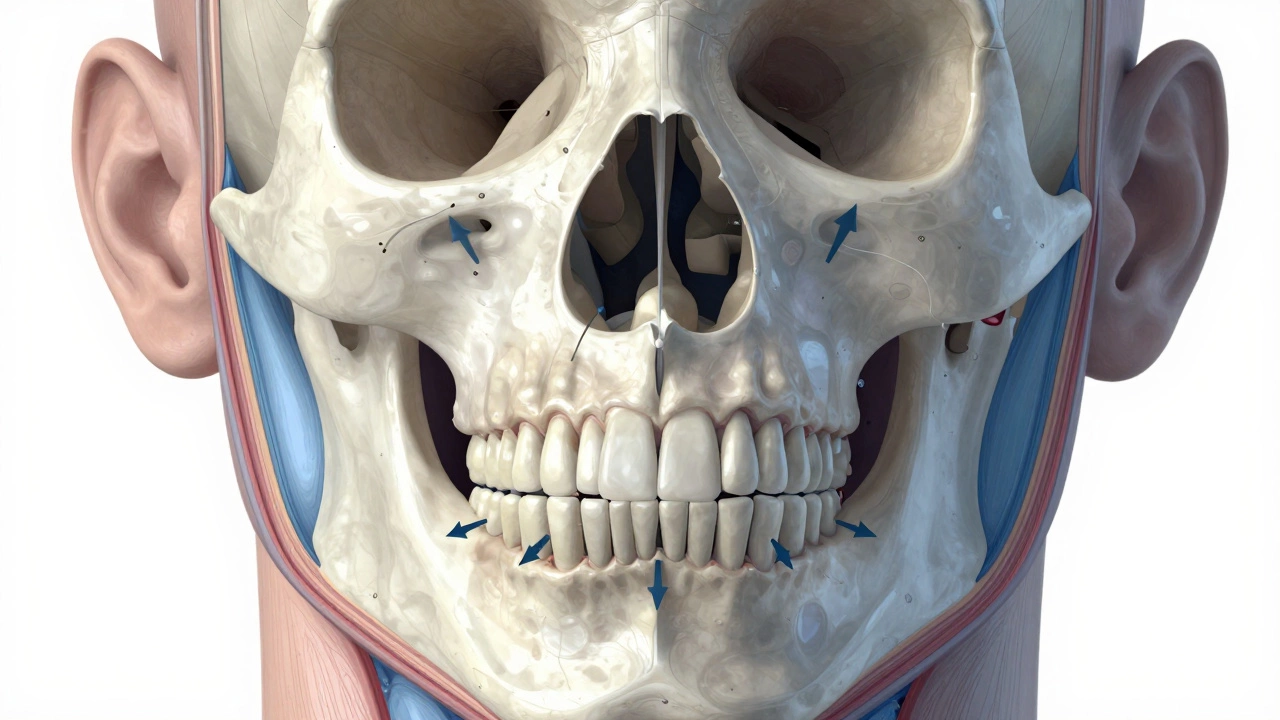
Most anti-aging products focus on skin. But your face is built on bone. And starting in your 40s, your facial bones start to shrink. The jawbone recedes. The eye sockets widen. The nasal bone loses height. This isn’t just about skin sagging - it’s about the foundation giving way.
A 2021 study from the University of California, San Francisco, used CT scans to compare facial bones of people aged 20 to 70. By age 45, men and women alike lost an average of 0.7 millimeters of bone mass per year in the maxilla (upper jaw). That might sound tiny, but over a decade, it adds up. That’s why your smile looks different. Why your lips seem thinner. Why your nose looks longer. It’s not aging skin - it’s aging bone.
What Happens After 50? The Domino Effect
After 50, everything accelerates. Estrogen drops sharply in women, which speeds up collagen loss. Men see a slower decline in testosterone, but muscle mass in the face still drops. Gravity pulls harder. Fat redistributes - often pooling under the chin and jaw. You get jowls. Your neck gets heavy. Your eyelids droop.
By 60, most people have lost 30-40% of the volume they had in their 20s. That’s not just wrinkles. That’s a whole new face shape. That’s why some people look completely different at 60 than they did at 40 - not because of makeup or filters, but because their underlying structure has changed.
Can You Slow It Down?
Yes - but not by slathering on expensive creams alone. You need a three-pronged approach:
- Protect your skin daily - sunscreen with SPF 30+ is non-negotiable. UV exposure causes 80% of visible aging.
- Support collagen - topical retinoids (like tretinoin) and peptides have proven results. Oral supplements with vitamin C, zinc, and hyaluronic acid help too.
- Strengthen your foundation - facial exercises, resistance training, and even chewing gum can help maintain muscle tone. Bone loss can’t be reversed, but muscle can be trained to hold skin tighter.
Professional treatments like fillers, radiofrequency, and laser skin tightening can help, but they’re temporary. The real game-changer? Starting early. If you’re in your 30s, you still have time to build resilience. If you’re in your 40s, you’re not too late - you’re at the perfect moment to act before the collapse gets worse.
What You Should Stop Doing
Stop believing that expensive serums will fix bone loss. Stop thinking that drinking water alone will plump your skin. Stop using harsh scrubs that damage your barrier. And stop blaming your genetics - they play a role, but lifestyle controls 70% of how your face ages.
Too much sugar? It causes glycation - a process where sugar molecules stick to collagen and make it brittle. Too little sleep? Your skin repairs itself between 10 p.m. and 2 a.m. Miss that window, and you’re losing repair time every night.

Real-Life Examples
I’ve seen clients in my Brighton clinic who looked dramatically different at 48 than they did at 38 - not because they gained weight, but because they stopped protecting their skin. One woman, 46, had deep nasolabial folds and hollow cheeks. She’d been using a $200 night cream but never wore sunscreen. Once she started daily SPF, added a retinol serum, and cut out sugar, her skin texture improved in 4 months. Her volume didn’t come back - but it stopped sinking.
Another man, 51, noticed his jawline disappearing. He started doing facial resistance exercises (yes, they exist) and doing chin tucks daily. Within 6 months, his neck looked firmer. His face looked less tired. He didn’t need fillers. He just retrained his muscles.
When to Seek Help
If you’re noticing:
- Deep lines that don’t fade when you smile
- Loss of cheek definition
- A double chin that doesn’t go away with weight loss
- Thinner lips or a longer nose
It’s not vanity - it’s biology. And you can do something about it. Dermatologists can offer treatments like hyaluronic acid fillers, PDO threads, or ultrasound skin tightening. But even without procedures, you can slow the decline. The key is acting before the damage becomes structural.
The Bottom Line
Your face changes most between 40 and 50. Not because of wrinkles. Not because of stress. But because your skin, fat, and bone all start to give way at once. What you do in your 30s and early 40s determines how much you lose. Sunscreen, retinoids, sleep, diet, and muscle tone matter more than any cream you’ve ever bought. You can’t stop aging - but you can control how fast your face collapses.
Is it normal to see changes in your face at 30?
Yes. It’s normal to see fine lines, dark circles, or slight loss of firmness in your 30s. These are mostly due to sun exposure, lifestyle, and slowing collagen production. But this is not the major structural change - that comes later. Early signs are manageable with consistent skincare and sun protection.
Do men and women age differently?
Yes. Women often see faster skin changes in their 40s due to estrogen drop during perimenopause. Men tend to lose volume more slowly but are more prone to sagging skin and jowls in their 50s and 60s because of muscle loss and gravity. Bone loss affects both genders similarly.
Can facial exercises really make a difference?
Yes, if done consistently. A 2020 study in JAMA Dermatology found that 20 minutes of daily facial exercises for 20 weeks improved cheek fullness and reduced sagging. These exercises strengthen the underlying muscles, which helps hold skin in place. They won’t erase wrinkles, but they can improve contour and tone.
Are fillers the only solution for volume loss?
No. Fillers help, but they’re temporary. Long-term solutions include lifestyle changes - reducing sugar, quitting smoking, using retinoids, and protecting your skin from the sun. These slow further volume loss. Some people also benefit from radiofrequency or ultrasound devices that stimulate collagen production over time.
Does weight gain or loss affect facial aging?
Yes. Weight gain can temporarily fill out hollow areas, making you look younger. But when you lose weight, especially after 40, you lose fat pads that don’t come back. Rapid weight loss can make your face look gaunt. Slow, steady changes are better for maintaining facial structure.